What is DDC or Direct Digital Controller in BMS System?
By Hamza Mohamed Ansari · Published 15 April 2019 · Updated 5 October 2020 ·4 min read
Have a question about this topic? Message Hamza on WhatsApp and get a reply from the author.
What is DDC ?
To understand the DDC, we need to know a little bit of history about what was the things before the DDC invention and why it was invented? So that we can have a broader view of the primary purpose of DDCs.
The Programmable Logic Controller or PLC used to control and monitor the Process mainly in the industry like automobile and other manufacturing factories.
Richard Morley invented PLC in 1968 to fulfil the primary needs of control and protect the production capacity of machines and manufacturing lines in the industry, and this PLC used initially was in the area of transfer lines in automotive plants.
Due to these PLC or Programmable logic controllers were designed and invented mainly for controlling and monitoring or automating the productions in the industry.
But when it comes to buildings, these PLC cannot fulfil the exact needs in terms of tenants comfort, environmentally green or can say effective management system for buildings. And still, we can use PLC for Building automation whereas it will be an excessive investment and different performance.
So here DDC or direct digital controller invented in order the process and automated the building equipment needs almost which PLC can do with minimal investment from installation to engineering.
What is the Main Difference between PLC and DDC?
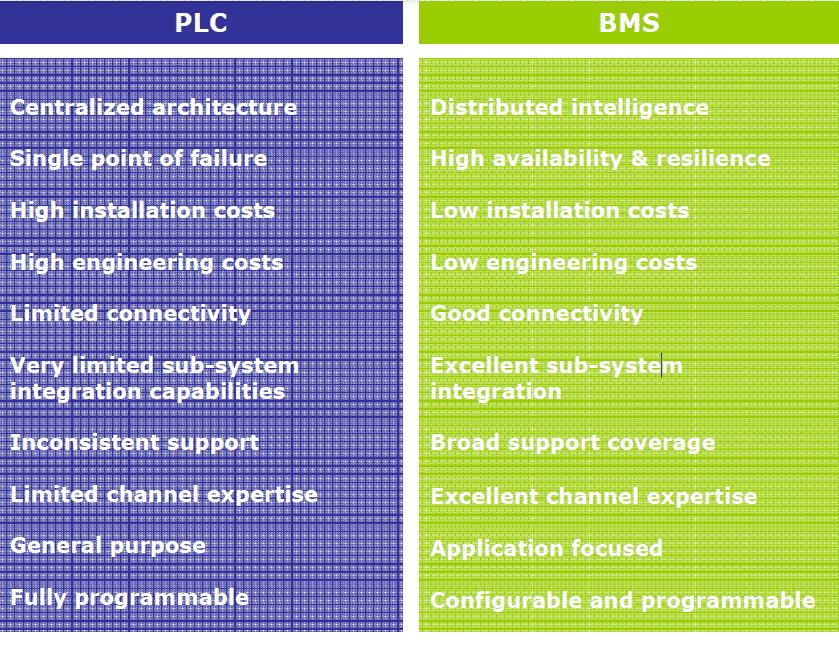
Read more about PLC Vs DDC on here
What is DDC or Direct Digital Controller?
In a nutshell, DDC is a controller which use the analogue or digital signals from various devices of a field sensor and actuators and then process and control the system based on the programme written inside the controllers and has the capability to sends the information to another controller or DDC.
Basic Features of DDC
DDC or Direct digital controller usually has the followings features
- The Analogue Inputs is to monitors the fields sensors values.
- Digital Inputs to monitors the on/off status from switches/contactors.
- The analogue output is to control the field actuators devices.
Digital Output is to control relay or provide low voltages. - DDC must have internal ROM/RAM to store control logic and sensor values.
- It must have networking protocols inbuilt to transfer the data between the devices.
- Modern DDC controller should have the capability to implement BACnet protocols for communication.
Note that there are various DDC controllers available in the market from the different manufacturer and those DDCs are available with a variety of function and features based on the specific needs like controller has all inputs/outputs like Analog inputs, Digital input, analogue output and digital output and some controller has only digital/analogue inputs.
Let us see some DDC Controller from Alerton Honeywell.

- Eleven 10-bit universal inputs whereas we connect either analogue input or digital input using a jumper select, eight binary outputs, and eight analogue outputs.
- Terminal 23,24 used to connect other DDC controller to communicate between devices through BACnet over MSTP.
- It has non-volatile memory used to store program and work independently.
- It has the 24vdc used to give power for field devices.
How DDC used to control the BMS System?
Consider the followings scenario which we need to control and monitor through above DDC
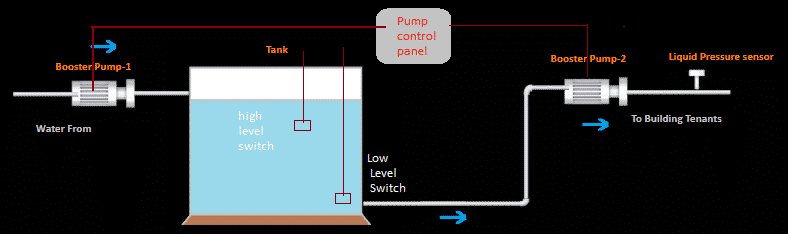
Let us say in Building, we need to control Pump control and control filling sequence through DDC whereas we have
2 Booster pumpS, one is for filling the water tank and other is to pump the water to buildings purpose to tenants like toilet etc.
This two-pump motor is controlled through the pump control panel by manually and it should work automatically based on the following sequence
- Pump-1 should run if the water level below the high level and stops once above the high level.
- Pump-2 should run if the pressure on the supply line lesser than the defines let us say 2.5bar.
- Pump-2 Should not run if water lesser than the lower level switch even pressure lesser than defined.
So based on the above sequence we will have following parameters to monitor and control
- Booster pump-1 Run status from control panel-Binary Input
- Booster pump-1 Run command from control panel-Binary output
- Booster pump-2 Run status from control panel-Binary Input
- Booster pump-2 Run command from control panel-Binary output
- Water Low-Level status-Binary Input
- Water High-Level status-Binary input
- Liquid pressure on supply line-Analog Input
Let us connect the above points in DDC Controllers as follows
BP-1 Run sts- IN-1
BP-2 Run sts- IN-2
Low-Level Sts- IN-3
High-Level Sts-IN-4
Liquid Pressure-IN-5
BP-1 Run Command-BO-0
Bp-2 Run Command-BO-1
Logic will be as follows to execute the above sequence
If IN4==1 ##(means lesser than high-level status)
then
BP1=1 ##(On Pump)
else ##(means above than high-level status)
BP1=0 ##(Off-Pump)
endif
If (IN5<2.5 and IN4==1) ##( if pressure lesser than 2.5bar and water above the low-level sts)
then BP2=1 ##(on Pump)
else
BP2=0 ##(Off-Pump)
endif
Note that this program may change for each vendor controllers.
Not only this small sequence but also DDC can execute complex and critical sequence in BMS System for HVAC
Share and comment if need any better explanation
Have a question about this topic? Message Hamza on WhatsApp and get a reply from the author.
BMSDDCPLC
Related articles
14 reader comments
Comments from the original article. Have a question? Ask on WhatsApp.
Bruce K McBride21 November 2020
Once again another article on DDC Systems touting advantages WITHOUT supply any sort of Cost Metric comparisons. Sheeeesh. Learn what is important to potential clients!
Davinder Singh7 March 2021
I was trying to search something for BMS integration part to my PLC System. Fortunately I read this PLC/BMS comparison, this made me ROFL. Whoever wrote it either have no or very limited knowledge about PLC system. Thanks you for article, I had a good laugh.
abdla3 June 2021
can you explain difference in below again ..
If IN4==1 ##(means lesser than high-level status)
If (IN5<2.5 and IN4==1) ##( if pressure lesser than 2.5bar and water above the low-level sts)thanks alot
Ver Dimalanta26 June 2021
I do not agree with the differences you have listed.
PLC is much much better than DDC.
Centralized architecture – for DCS yes, but not for single controller so you can choose to go on single or distributed control.
Single Point Failure – you can implement redundancy.
High installation cost – its the same,
High engineering cost – minimal.
Limited connectivity – Better connectivity (Ethernet, Serial) Multi protocol support
Very limited subsystem integration capability – better, there are PLC you can choose with Bacnet connectivity other are Modbus, CAN
Inconsistent Support – Multi level Support, almost all electrician can program in Ladder Programming.
Limited Channel expertise – No, Multi Channel Expertise
General Purpose – Yes, which is better, I can even put all nice features from different DDC features into a PLC, it is flexible.
Fully Programmable – Correct, which is much better.What about robustness? Robust that it can withstand very high temp without ventilation or Fan designed for harsh environment.
HamzaAuthor26 June 2021
I do agree your points,.
Its not actually PLC vs DDC.
Difference of purposes…
Each has its own unqiue functionality.
Industrial/factory VS buildings..
I
Ver Dimalanta26 June 2021
Correct your statements of differences.
DDC will soon be supersede by PLCPLC SCADA is now the futures.
SCADA was for industrial before but not anymore there is now Facilities SCADAHamzaAuthor26 June 2021
Noted…and will update the info..dear
Ver Dimalanta26 June 2021
https://affinityenergy.com/medical-campus-central-utility-plants-use-plc-not-ddc-controls/
Read this it might change your mindset
HamzaAuthor26 June 2021
Thanks for link ver dimalanta..will check it out brother
RAMOS, Reynaldo13 August 2021
Hello .. i would just like to ask something importrant about BMS. Where should the Direct Digital Controller be placed ideally? Hope you can provide me with this answer. Thank you.
Tariq3 September 2022
It varies as per site conditions, however the basic criteria is to find a place where you get :
1. Minimum copper cable run.
2. Concentration of the relevant equipment.
3. Better environmental condition. (wet area, dust, chemicals, sun, safe working space i.e. clearance, light).
4. Within the communication cable limits.HamzaAuthor3 September 2022
👍
Tariq3 September 2022
BMS/DDC has pre tailored programs, specially for HVAC , Chilled Water System controls and several more schemes.
HamzaAuthor3 September 2022
👍